What to do when you've done the obvious stuff.
Huntsville has never been especially interested in subtlety. There is a 363-foot Saturn V lying inside a museum on the west side of town, beneath a skyline of rockets visible from the interstate. We put space hardware in parks, paint it on walls and use it for directions.
That is the starter pack.
The city gets more interesting once you begin looking around the edges: inside the rocket museum rather than at it, underneath an old hardware store, among the studios of a former textile mill or on a mountain where volunteers still point telescopes at the night sky.
These places are not all secrets. Some are well known. The point is to approach them differently—and notice the details that make Huntsville feel like Huntsville. If you want the backstory first, start with How Huntsville Became the Rocket City.
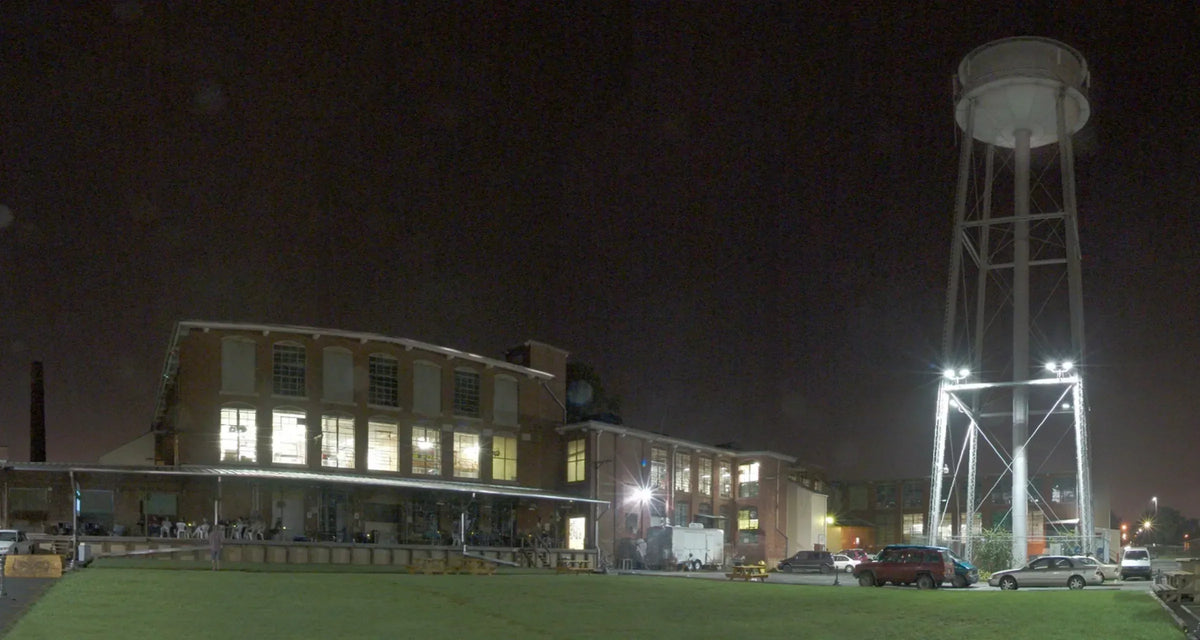
Lowe Mill Arts & Entertainment. Public-domain photograph by GBilliter.
SPACE-AGE STRANGE
Hunt for the hardware inside the U.S. Space & Rocket Center
The standard advice is to visit the U.S. Space & Rocket Center. Better advice is to treat the place like an artifact hunt.
Start with the National Historic Landmark Saturn V inside the Davidson Center, but do not stop at the enormous object designed to overwhelm the room. Look for the smaller pieces that explain how people actually lived and worked in space: the Apollo 16 command module, Apollo 12 moon rock, Skylab hardware and the less glamorous mechanical details behind the mythology.

Outside, Pathfinder presents its own piece of Huntsville logic: a full-stack space-shuttle display. Elsewhere on the grounds is the memorial for Miss Baker, the squirrel monkey whose 1959 flight helped establish that humans could survive spaceflight.
The Rocket Center also publishes an artifact and selfie trail that can give the visit some structure. Exhibits and access can change, so check the current map before building the day around one particular object.
Where: U.S. Space & Rocket Center, west Huntsville
Cost: Paid admission
Good to know: The interesting part is not checking “rocket museum” off a list. It is finding the hardware that made the giant machines possible.
Let local astronomers run Saturday night
Huntsville putting a volunteer astronomical society on top of a mountain feels almost inevitable. Apparently one major space institution was not enough.
The Von Braun Astronomical Society operates a planetarium and observatories inside Monte Sano State Park. Its public Saturday programs are presenter-led rather than anonymous films running on a loop. Topics change, the current night sky gets explained and the audience can ask questions of somebody who has spent time learning the material.
When weather cooperates, telescope viewing follows the program. That final part is never guaranteed—clouds remain unimpressed by Huntsville’s aerospace résumé—but it is what makes the evening more than another indoor presentation.
Programs currently begin at 7:30 p.m., with tickets sold at the door. First-time visitors should arrive early and, preferably, before dark. The facility sits beyond the main park entrance and shows can fill.
Where: Monte Sano State Park
Cost: Ticketed, inexpensive
Good to know: Telescope viewing is weather dependent. Check the current program before heading up the mountain.
Look for the Space Age on the side of a church
The Space Race did not stay confined to laboratories and launch facilities. It leaked into Huntsville’s architecture.

First Baptist Church on Governors Drive is fronted by a huge mosaic commonly known as Cosmic Christ. The mosaic and the church’s rocket-like bell tower are pure Space Age Huntsville: old institutions living through a city being remade by rockets.
The mosaic was developed during the Apollo era, and its abstract figure is surrounded by cosmic imagery. The church describes it as its largest display of public art. Tiles removed during restoration have since been reused in community art projects, including space-related pieces elsewhere in Huntsville.
This remains an active place of worship, not an abandoned architectural curiosity. The easiest respectful view is from outside, where the building can be appreciated without interrupting church activity.
Where: First Baptist Church, Governors Drive
Cost: Free to view from public exterior areas
Good to know: Treat the building as a church first and an architectural stop second.
ART HIDING IN PLAIN SIGHT
Follow downtown’s Secret Art Trail
“Secret” is doing a little marketing work here. Downtown Huntsville publishes the route. There is a map. Some of the art sits beside streets thousands of people use every week.
Finding it still requires paying attention.
The official Secret Art Trail connects 13 primary works, plus three bonus pieces, through downtown. The collection includes sculptures, murals and smaller interventions that are easy to pass when the objective is getting from a parking garage to dinner.
A related segment around Big Spring Park honors Mae Jemison through painted utility boxes. The result is a free way to see how Huntsville layers art and space history into ordinary infrastructure. We hide rockets downtown as though the full-size ones were too restrained.
The trail is self-guided, so it can fill an afternoon or become a detour between other stops. Check the current route before going; downtown construction and public-art installations can change.
Where: Downtown Huntsville and Big Spring Park
Cost: Free
Good to know: Wear comfortable shoes and use the current official map rather than an old roundup.
Wander Lowe Mill, then find the pinball machines
Lowe Mill works best without a rigid itinerary.
The former textile mill now holds working studios, galleries, classes, food, tea, records and enough hallways to make getting slightly lost part of the visit. The useful distinction is “working.” This is not a building filled solely with finished objects behind glass. Artists and makers actively use the studios, although no particular person can be promised on a given day.
Give yourself time to move through more than the first floor. Ask before photographing inside a studio.
Then find StarLight Pinball Arcade inside the complex. Its classic machines turn the visit from observation into participation, with an all-day free-play format rather than a pocketful of quarters. The collection leans into older pinball and arcade hardware maintained by people who know the machines.
Lowe Mill is currently open Wednesday through Saturday from 11 a.m. to 7 p.m. StarLight opens at noon Wednesday through Friday and at 11 a.m. Saturday, closing at 7 p.m. Individual studios keep their own hours.
Where: Lowe Mill Arts & Entertainment, west Huntsville
Cost: Free building admission; paid arcade play and classes
Good to know: Check both Lowe Mill and StarLight hours. Do not assume every studio is staffed throughout the day.
Meet the giant troll in the garden
An enormous troll sits inside a living maze at Huntsville Botanical Garden. No embellishment was required for that sentence.
Artist Thomas Dambo is known internationally for large sculptures built around reclaimed materials, storytelling and environmental themes. Huntsville’s Mama Zelda incorporates locally salvaged wood and stone, with planted “hair” and a maze intended to change as the surrounding landscape grows.
The scale gets attention, but the smaller details make the installation worth exploring: hidden seating, reused material and the way the sculpture gradually merges with the garden around it. Mama Zelda is described by the Garden as a permanent resident rather than a short-term traveling exhibition, though naturally constructed artwork will still change with time and weather.
The exhibit is included with regular Garden admission.
An important access note: the maze has a mulched surface, and the Garden states that it is not wheelchair accessible. Benches are available outside the maze, but the interior path should not be presented as an accessible route. Climbing on the sculpture is prohibited.
Where: Huntsville Botanical Garden, west Huntsville
Cost: Paid Garden admission
Good to know: The maze surface limits wheelchair access; follow the Garden’s current visitor guidance.
Find a Japanese garden on Monte Sano
A tea house, bamboo, red bridges and 24 haiku stones are not what most people expect to encounter in an Alabama state park.
The North Alabama Japanese Garden sits within Monte Sano State Park and has grown through decades of volunteer effort. Its paths lead among traditional architectural elements, plantings, a pond and stones inscribed with haiku. The contrast is the point: a quiet Japanese-inspired garden on a mountain overlooking a city built around rockets and engineering.
The garden is accessible whenever the state park is open, currently 8 a.m. to sunset daily. It charges no separate admission beyond the state-park entrance fee. Spring and autumn celebrations add cultural programming, but an ordinary quiet day is a better fit for the evergreen guide.
The maintained paths are unpaved and include gentle inclines. There is no restroom inside the garden; the nearest facilities are behind the park office near the entrance.
Where: Monte Sano State Park
Cost: State-park entry applies
Good to know: Unpaved paths and inclines affect accessibility. Check park conditions before visiting.
HISTORY THAT STILL HAS A PULSE
Go below Harrison Brothers—if the calendar cooperates
Harrison Brothers Hardware has occupied its downtown building since the late 19th century and retains fixtures, counters and the commercial atmosphere that make it feel unlike a recreated museum shop. It now sells regional goods and contains a free Historic Huntsville Museum, but the building itself remains a major part of the experience.
The easier-to-miss stop is below it.
Historic Huntsville Foundation operates an Architectural Warehouse in the basement, holding salvaged pieces from local buildings: doors, hardware, mantels and other fragments that might otherwise have disappeared during renovation or demolition. It is part archive, part preservation workshop and part evidence locker for the city Huntsville used to be.
The catch is the schedule. Harrison Brothers and the museum currently operate Monday through Saturday from 10 a.m. to 5 p.m. The Architectural Warehouse opens only on the first and third Saturdays of the month, from 10 a.m. to noon. Verify before making a special trip. Do not arrive on an ordinary afternoon expecting basement access.
Where: Downtown Huntsville
Cost: Free to browse
Good to know: The Warehouse’s limited schedule needs same-week verification; confirm basement accessibility directly if needed.
Walk the rail yard, then watch the excursion calendar
The North Alabama Railroad Museum occupies the Chase Depot site northeast of central Huntsville. The grounds and preserved rolling stock provide a quieter version of transportation history than a polished indoor museum.

Visitors can ordinarily take a free self-guided walking tour. Volunteer staff are currently present on Wednesday and Saturday mornings, but the museum may occasionally close for private events. Visitors must stay off the tracks, avoid climbing on equipment and follow posted signs.
The stronger experience depends on timing. The museum operates scheduled excursion trains during selected parts of the year, turning static equipment into a ride through the local landscape. These trips are ticketed, do not run daily and can sell out. A train displayed on the property is not evidence that one will depart that afternoon.
That distinction matters: the museum belongs in the evergreen guide, while an excursion belongs on the calendar.
Where: Chase, northeast Huntsville
Cost: Self-guided grounds visit is free; excursion rides are ticketed
Good to know: Check the official ride schedule and reserve ahead when required.
Spend an hour in Alabama before it looked like this
Mooresville is outside Huntsville proper, west of the city near the Limestone County line. It belongs here because it works naturally as a Huntsville-area outing—and because it is a living town rather than a manufactured historical attraction.

Incorporated in 1818, Mooresville remains a National Register historic district. Its small grid includes an 1840 post-office building, early churches, historic homes and the circa-1821 Stagecoach Inn and Tavern.
The historic district can be viewed from public streets and sidewalks. What that does not provide is permission to treat private residences as exhibits. People live here. Stay on public routes, respect gardens and fences, and do not assume a historic building will be open.
Commercial photography requires additional care, and the town has historically required permits. Confirm current requirements before arranging a branded shoot.
Where: Mooresville, outside Huntsville proper
Cost: Free to view from public streets; guided tours and events may differ
Good to know: Building access is limited. Respect private homes and verify photography rules.
WHEN THE TIMING IS RIGHT
Some of the area’s strangest experiences do not keep normal business hours. They appear on a calendar, happen for a few weekends and disappear again.
Concert at Three Caves
Three Caves is a former limestone quarry used for authorized events, including limited-date concerts. Music against the stone walls makes the setting worth the logistical effort.
This is not an invitation to explore a cave independently: public access is event-controlled, there is no event parking at Three Caves, and the venue surface is gravel. The Land Trust provides specific transportation and accessibility instructions for each event. Check its current calendar rather than assuming the concert occurs on the same date every year.
Maple Hill Cemetery Stroll

The annual Cemetery Stroll is a living-history program, not a haunted attraction. Costumed interpreters tell the stories of people buried at Maple Hill, with historical exhibits and music throughout the grounds.
It is held during the fall, remains weather dependent and brings significant traffic into a quiet residential area. Follow current parking guidance and treat the cemetery accordingly.
Huntsville Ghost Walks
Huntsville’s Ghost Walks use Downtown, Old Town and Twickenham routes to mix local history with folklore and reported legends. The stories are part of the experience; supernatural claims are not presented here as verified fact.
The walks currently operate on selected September and October evenings, begin at Harrison Brothers and require reservations. Consult the current schedule before choosing a route.
North Alabama Railroad Museum excursions
The Chase museum can be visited through much of the year, but train rides follow a limited schedule. Seasonal excursions sell separately from ordinary museum access and may require advance reservations. Check the current calendar rather than assuming a train runs every weekend.
KEEP LOOKING AROUND THE EDGES
This is not a complete inventory, and it should not become one.
Places open. Studios move. Trails change. Somebody puts a giant recycled troll in a botanical garden and suddenly the definition of a normal Tuesday needs revision.
The useful habit is paying attention: to what is behind the obvious exhibit, beneath the familiar storefront and just far enough outside the standard itinerary to reveal another piece of Huntsville.
If there’s a current local oddity we missed, bring it to the Things to Do section of the KHS Community. Give people enough detail to find it—and enough warning if it requires a reservation, good weather or a very specific Saturday morning.
SOURCES & FURTHER READING
- U.S. Space & Rocket Center overview
- Von Braun Astronomical Society events
- VBAS visitor directions
- Downtown Huntsville Secret Art Trail
- First Baptist Huntsville Arts Ministry
- Lowe Mill Arts & Entertainment
- StarLight Pinball Arcade
- Mother Earth Troll Garden
- North Alabama Japanese Garden
- Harrison Brothers museum
- Historic Huntsville Foundation visitor information
- North Alabama Railroad Museum
- NPS Mooresville Historic District record
- Land Trust Concert at Three Caves
- Maple Hill Cemetery Stroll
- Huntsville Ghost Walk