
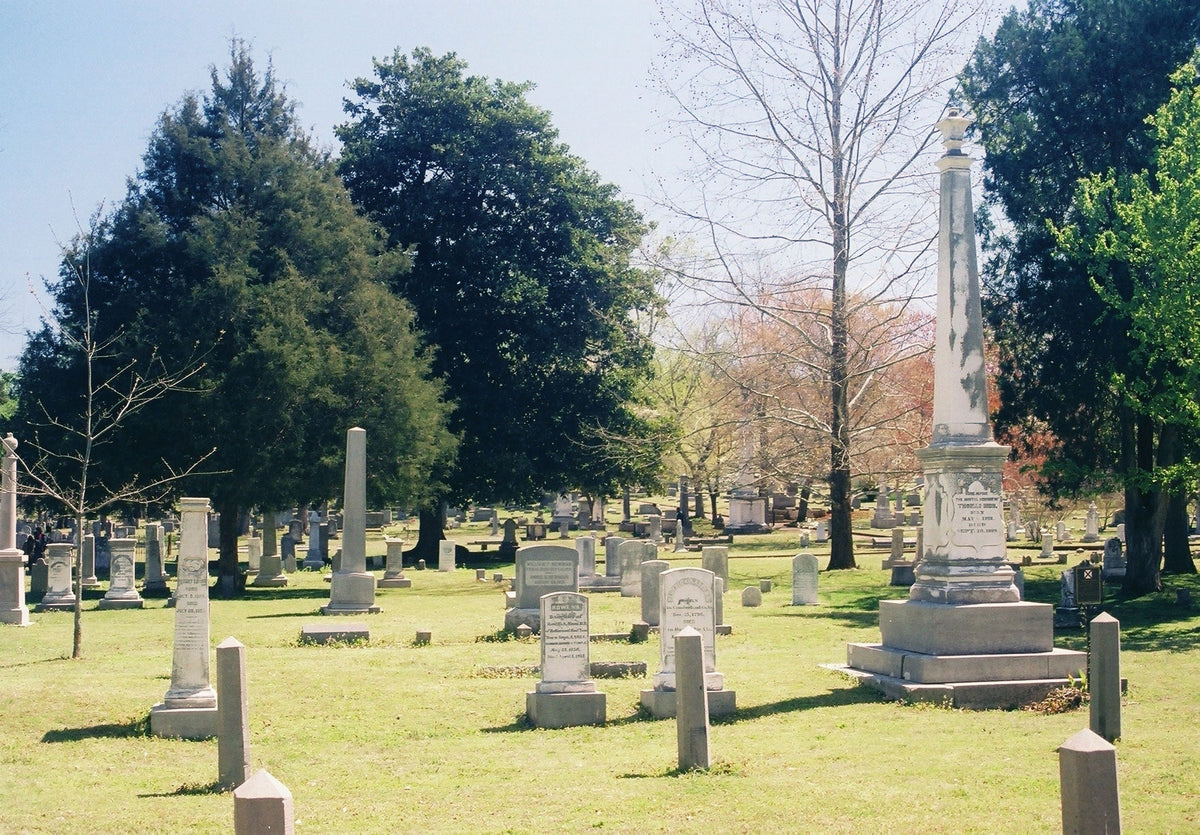
Long before Huntsville became the Rocket City—before Redstone Arsenal, NASA, Research Park, and Memorial Parkway became a full-contact commuting experience—the city was already burying its dead on a hillside east of town.
That hillside became Maple Hill Cemetery, and more than 200 years later, it remains one of Huntsville’s most interesting, historic, and appropriately strange places.
The City of Huntsville established Maple Hill in 1818. What began on roughly two acres eventually grew into an 81-acre cemetery, and the City still operates it today. According to the City of Huntsville, it is the city’s oldest and largest cemetery.
That alone would make it worth exploring. But this is Huntsville, so naturally we also ended up with haunted mausoleums, ghostly carriages, mysterious lights, phantom children, swings that supposedly move on their own, and a nearby playground generations of locals have casually referred to as Dead Children’s Playground.
Because apparently even our cemetery had to be weird.
Where Huntsville Keeps Its Past
Walking through Maple Hill doesn’t feel much like walking through a modern cemetery. Weathered stones, family plots, old mausoleums, massive trees, narrow roads, and generations of monuments make parts of it feel like another century is still hanging around.
And in a way, it is. Five former Alabama governors and five former U.S. senators are buried at Maple Hill, according to the City. Veterans buried there span conflicts reaching back to the Revolutionary War, and a recent City mapping project identified more than 2,200 veterans among an estimated 80,000 to 100,000 people interred there. The City even created a digital cemetery map to help locate them.
If you want a crash course in Huntsville history, you could do a lot worse than spending an afternoon reading gravestones.
Just maybe do it before dark if you’re the kind of person who suddenly remembers every horror movie you’ve ever seen as soon as the sun disappears.

The People Buried Here Are Basically Huntsville History
The names at Maple Hill span politics, war, business, scandal, tragedy, and more than a few stories that sound like somebody deliberately tried to make history entertaining.
One of them is LeRoy Pope Walker, a Huntsville attorney and politician who became the Confederacy’s first Secretary of War. He later returned to law and represented Frank James, brother of outlaw Jesse James. The City’s own history of the annual Cemetery Stroll is full of characters like Walker: governors, senators, notorious locals, and people whose stories never made it into the average school textbook.

And then there’s Lily Flagg.
Lily Flagg was not a governor, senator, war hero, or industrialist.
She was a cow.
A very successful cow.
The Jersey became a Huntsville celebrity in the late 1800s after setting a remarkable butter-production record. She became such a local legend that costumed interpreters still bring her story to life during the Maple Hill Cemetery Stroll. The City’s account of the Stroll notes that she drew some of the event’s biggest crowds.
This is exactly the kind of history we appreciate around here. You can keep your marble statues—we have celebrity livestock.
And Then Things Get Weird
Every old cemetery collects stories. Maple Hill apparently decided to collect an entire franchise.
One of its best-known legends surrounds Mary Chambers Bibb, who died in 1835. According to Huntsville folklore, Mary was accidentally poisoned around the time of her wedding. Her husband, William, had a mausoleum built for her, and the story claims she was placed inside wearing her wedding dress and seated upright in her favorite rocking chair.
The particularly cheerful part comes next.
Legend says that if someone knocks on the mausoleum, they may hear the rocking chair creaking inside. The story is folklore rather than established historical fact, but that distinction has done absolutely nothing to stop Huntsville from telling it for generations. Huntsville/Madison County tourism still includes the Bibb story among the city’s best-known haunted legends.
Is it documented history? No.
Would we be knocking on that mausoleum after midnight to check?
Also no.
Some mysteries are perfectly fine remaining mysteries.
The Ghostly Governor
Mary Bibb isn’t the only member of the Bibb family who apparently had trouble staying put.
Former Alabama Governor Thomas Bibb died in 1839 while visiting New Orleans. He was initially buried at his Belle Mina plantation in Limestone County, but his remains were later moved to Maple Hill.
According to legend, Bibb’s spirit was not thrilled about the relocation. The story says that on certain moonlit nights, a glowing carriage pulled by white horses appears near his grave. The former governor climbs aboard and rides through the cemetery, supposedly trying to find his way home.
Which raises an important modern question: does a ghost carriage have to stop at Huntsville traffic lights?
Because if so, even death won’t get you around the Parkway.
Dead Children’s Playground
Then we arrive at the location that practically guarantees Huntsville a permanent spot on Alabama’s paranormal map: Dead Children’s Playground.
Yes, that is what locals actually call it.
The playground sits in the wooded area beside Maple Hill Cemetery. During the day, it is a city park and playground. After dark—at least according to local legend—things become considerably less normal.
Stories have circulated for years about swings moving without anyone touching them, the sound of children laughing when the playground is empty, unexplained lights, shadowy figures, and children appearing briefly before vanishing. The USC Digital Folklore Archives documents the legend as a piece of Huntsville folklore, while local tourism sources continue to include it among the city’s best-known haunted places.
Like most good ghost stories, the tale has accumulated extra layers over time. One popular version connects the spirits to children who died during the 1918 influenza epidemic. Other versions involve far darker claims. The problem is that the historical record does not clearly support those connections, and researchers have repeatedly noted the gap between the documented history and the stories that grew around the park.
So what is actually going on there?
Probably some combination of old cemetery atmosphere, dark woods, moving air, imagination, and several decades of people daring their friends to visit at night.
Or ghosts.
We’re not here to ruin October.
History vs. Legend
This is where Maple Hill becomes more interesting than a generic “haunted places” list.
The cemetery already has enough documented history without embellishment, but the folklore surrounding it has become part of Huntsville culture in its own right.
There’s the history: graves, records, dates, public figures, wars, families, epidemics, and more than two centuries of people who lived here.
Then there’s the legend: rocking chairs behind mausoleum walls, spectral carriages, children laughing in empty woods, moving swings, mysterious lights, and stories passed from one generation of Huntsvillians to another.
You don’t have to pretend the two are the same thing to enjoy both.
A legend can tell you something about a place even when the supernatural part can’t be proven. It shows what a community remembers, what scares people, what fascinates them, and which stories simply refuse to die.
That’s history too.
Just the messier kind.
Even the Rocket City Eventually Ended Up Here
Maple Hill’s story does not stop in the 1800s. The cemetery also holds people connected to the era that transformed Huntsville into the Rocket City.
Among them is Konrad Dannenberg, a rocket engineer who later worked in Huntsville’s space program and became closely associated with the development of American launch vehicles. His grave is a reminder that Maple Hill is not a frozen snapshot of antebellum Huntsville—it is a running record of the city’s evolution.

A Darker Part of Huntsville’s Cemetery History
Not every uncomfortable story around Huntsville’s old cemeteries involves ghosts.
On September 3, 1818, Huntsville’s City Commissioners purchased two acres from LeRoy Pope to serve as a burial ground for enslaved people. The cemetery became known within the Black community as Georgia and remained in use until 1870, when Glenwood Cemetery became the city’s designated burial ground for African Americans. According to the City’s historic marker, no known burial records from the original cemetery survive.
That history is documented by the City of Huntsville, and it matters because cemeteries tell us more than who lived in a city. They also reveal how that city treated people after death—who received elaborate monuments, who received simple markers, and whose names were allowed to disappear from the record altogether.
There’s nothing supernatural about that part of Huntsville history. It’s simply real, and sometimes the real stories are heavier than the ghost stories.
The Maple Hill Cemetery Stroll Returns October 18
If you want to experience Maple Hill without wandering around alone like somebody determined to become the first five minutes of a horror movie, the Maple Hill Cemetery Stroll is the way to do it.
The 2026 Stroll takes place Sunday, October 18, from 1:30 p.m. to 4:30 p.m. at Maple Hill Cemetery. More than 75 costumed characters portray people from Huntsville’s past near their gravesites, joined by music, historical exhibits, antique vehicles, and scavenger hunts. Admission is free, with donations encouraged to support preservation efforts.
View the official 2026 Maple Hill Cemetery Stroll details here.
The event has grown into one of America’s largest living-history cemetery strolls, and it manages to pull off something surprisingly difficult: teaching people history without making it feel like homework.
You’ll probably leave knowing more about Huntsville.
You may also become the person at dinner who starts every sentence with, “Actually, did you know…”
Use this power responsibly.
Why Maple Hill Matters
The ghost stories are fun. The legends are fun. The fact that Huntsville has a place widely known as Dead Children’s Playground is objectively ridiculous in the best possible way.
But Maple Hill matters for a bigger reason.
It is one of the places where Huntsville’s past remains physically visible. Before rockets, aerospace, Research Park, population booms, and endless announcements about the newest thing coming to town, generations of people were already living here, building businesses, fighting wars, raising families, making terrible decisions, dying, and leaving pieces of their stories behind.
Some became famous. Most didn’t.
Together, they built the city underneath the city we know today.
Maple Hill is basically Huntsville’s hard drive—except the files are engraved on stone, and some of them may creak from inside a mausoleum after dark.
So, Is Maple Hill Haunted?
We have no idea.
And we kind of hope nobody ever proves it either way.
Maybe the swings really move by themselves. Maybe Mary Bibb’s rocking chair really does creak behind the mausoleum walls. Maybe Governor Bibb is still trying to hitch a supernatural ride back toward Limestone County.
Or maybe old cemeteries, dark woods, wind, imagination, and two centuries of storytelling are more than enough to create ghosts on their own.
Either way, Maple Hill deserves a visit.
Go during the day. Read the stones. Learn about the people who were here before us. Come back for the Cemetery Stroll.
And if you hear someone quietly whisper your name when nobody else is around?
Keep walking.
You already have enough problems.
Keep Huntsville Strange. 👻🚀
Sources & further reading:
City of Huntsville — Maple Hill Cemetery Historic Marker
City of Huntsville — Maple Hill history and expansion
Huntsville/Madison County CVB — Haunted Huntsville
Official Maple Hill Cemetery Stroll — 2026
City of Huntsville — Historic Slave Cemetery Marker
USC Digital Folklore Archives — Dead Children’s Playground